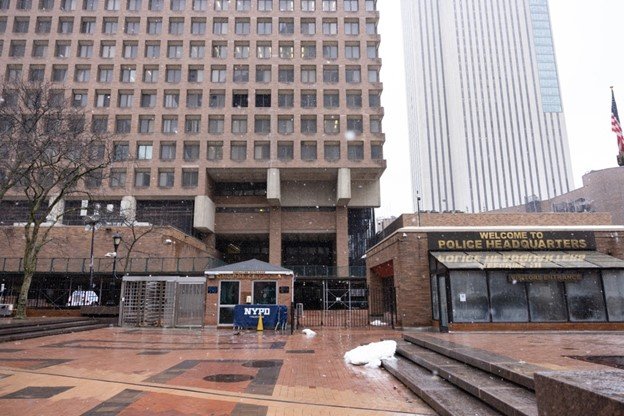
Five days after Jeffrey Epstein was arrested in July 2019, federal officials instructed the New York City Police Department (NYPD) to halt its related investigations, according to newly released Department of Justice records. The directive applied to the department’s Special Victims Unit (SVU), which investigates sex crimes and child abuse.
At the time, the Manhattan District Attorney’s Office (DANY) had an active investigation involving Epstein’s victims. Internal emails indicate federal authorities assumed that inquiry would also cease after the FBI ordered that “all Epstein stuff” be routed through federal channels.
These disclosures are part of a sweeping timeline covering 1996–2025, now the most detailed public account of how New York law enforcement responded—or failed to respond—to allegations involving Epstein, Ghislaine Maxwell, and other potential co-conspirators. The record reflects systemic lapses alongside later prosecutions and renewed investigative efforts. New York, a central hub of Epstein’s network, figures prominently throughout.
Recently, Raúl Torrez, Attorney General of New Mexico, revealed that his state’s investigation had been closed in 2019 at the request of the U.S. Attorney’s Office for the Southern District of New York. He has since ordered the matter reopened.
The broader chronology was compiled by legal scholars Ryan Goodman, Siven Watt, and Joshua Kolb in Timeline of Jeffrey Epstein–Ghislaine Maxwell Law Enforcement Failures (1996–2025) (Aug. 18, 2025).
Timeline: New York Law Enforcement and the Epstein Cases
August 29, 1996
Maria Farmer reported Epstein and Maxwell to the NYPD’s Sixth Precinct, alleging sexual abuse and ongoing crimes involving minors. Officers told her they could only address local threats and advised her to contact the FBI. The FBI did not open a formal investigation into Epstein until May 23, 2006.
June 30, 2008
Epstein pleaded guilty in Florida state court to felony solicitation of prostitution and procuring a minor for prostitution.
2008–2018
Despite mounting civil lawsuits and investigative reporting in the Southern Districts of New York and Florida, New York authorities took no major public action against Epstein or his associates during this decade.
January 18, 2011
Prosecutors under Manhattan District Attorney Cyrus Vance Jr. attempted to lower Epstein’s classification under New York’s Sex Offender Registration Act. Justice Ruth Pickholz rejected the move, expressing surprise at the request. A lower classification would have reduced public disclosure and limited lifetime registry requirements. Although the State Board of Examiners recommended the highest Level 3 status, confusion persisted over whether Epstein was required to check in with NYPD every 90 days. He did not. In 2019, NYPD stated that Epstein had relocated to the U.S. Virgin Islands before his first required check-in.
May 7–8, 2012
An Epstein associate—previously a victim—emailed him about NYPD detectives contacting her online. Epstein replied that he was unaware of any sex-related investigation.
December 6, 2018
The FBI’s New York Field Office opened a case after the Southern District of New York reported victims alleging abuse in the mid-2000s. The investigation included the NYPD/FBI Child Exploitation and Human Trafficking Task Force.
July 6, 2019
Epstein was arrested following a joint investigation by SDNY, the FBI, and NYPD. Federal officials publicly praised the NYPD’s partnership.
July 10–11, 2019
Internal emails show concern that DANY was conducting a parallel investigation and had contacted a victim for an interview. On July 11, officials noted that NYPD leadership had directed the Special Victims Unit to “stand down” and send all matters through the FBI. Later communications suggest federal authorities assumed DANY would also close its inquiry, though subsequent emails show uncertainty about whether that happened.
August 2019
New allegations were forwarded within NYPD and the joint task force even as primary jurisdiction shifted to federal control.
January 2020
FBI officials discussed whether NYPD and DANY investigations had formally closed. They assumed local probes had ended after Epstein’s death but acknowledged they were not certain.
July 2, 2020
Maxwell was arrested following a joint federal-local investigation. She was convicted in December 2021 and sentenced in June 2022 to 20 years in prison.
2020–2023
Victims continued reporting assaults. Some indicated lapses in follow-up from NYPD detectives. DANY pursued allegations involving financier Leon Black, including claims that victims trafficked by Epstein and Maxwell were assaulted in New York. Internal summaries suggest prosecutors found certain allegations credible but viewed charges as unlikely. By mid-2024, references to the Black investigation appeared in the past tense.
March 11, 2025
In proceedings before the U.K. Financial Conduct Authority, former Barclays executive Jes Staley acknowledged having sexual intercourse with a woman introduced by Epstein, described as part of Epstein’s staff. Earlier litigation in the U.S. Virgin Islands alleged extensive correspondence and financial transfers between Staley and Epstein after Epstein’s 2008 conviction.
July 24, 2025
A joint FBI–NYPD PowerPoint presentation listed several prominent figures connected to the Epstein files. Next to the names of Jes Staley and Les Wexner appeared the notation “referred to state,” a designation not included beside other individuals on the slide.
From Maria Farmer’s 1996 report to the 2019 federal “stand down” order and the 2025 disclosures, the record documents nearly three decades of fragmented enforcement, jurisdictional tension, and delayed accountability. While federal prosecutions ultimately secured convictions against Epstein and Maxwell, the broader chronology highlights missed opportunities and unresolved questions about coordination among New York law enforcement agencies.